

As professionals and teams, we are constantly looking for ways to improve productivity and optimize our time. However, there is a silent leak that many companies overlook: the manual management of client meetings.
- Cross-posted emails until availability is found.
- Calls to confirm schedules.
- Internal messages to verify who can attend.
- Last-minute changes.
- Rescheduling.
- Cancellations without notice.
- Duplicate confirmations.
In many teams, this process is still commonplace. And since it has always been done this way, it seems normal.
But the real question is not whether it works.
The question is: how much is it really costing your team not to automate customer meeting management?
When we analyze time spent, errors, interruptions and missed opportunities, manual management ceases to be a "no-cost" task. It becomes a hidden operational cost that directly affects profitability and customer experience.
In this article we look at that real cost and why automating meeting management is not a luxury, but a strategic decision for any team, large or small.
The first hidden cost: the time your team wastes every day
To understand the real cost of not automating customer meeting management, we must first quantify the time. Imagine a small, agile team of two professionals who conservatively manage 15 customer meetings per month each.
When meeting management is done manually, each appointment involves a repetitive sequence of tasks:
-
Coordinating schedules: exchanging emails until an available date and time is found.
-
Checking availability: reviewing calendars and coordinating to avoid internal conflicts.
-
Manual confirmation: draft and send confirmation email with details and link to the meeting.
-
Manual reminders: manually send one or two reminder emails to reduce no-shows.
-
Rescheduling: Re-do the whole process if the customer needs to reschedule.
Each of these steps seems small, but they take minutes and when added together, they have a significant impact.
With a conservative calculation, we can estimate that manually managing a meeting consumes approximately 12 minutes. This may not seem like much, but the problem is not in the individual minutes but in the accumulation of time.
This situation becomes even more complex when managing team meetings involves coordinating the availability of several team members.
Example: The cumulative effect in a small team
If each professional manages 15 meetings per month:
15 meetings × 12 minutes = 180 minutes
That is, 3 hours per month per person.
In a two-person team:
3 hours × 2 = 6 hours per month dedicated exclusively to coordinating meetings.
In a year:
6 hours × 12 months = 72 hours per year.
That equals almost two full workweeks spent solely on administrative tasks related to scheduling meetings.
The second hidden cost: money that leaks out unnoticed.
Time is the most valuable asset of any team. And it has a direct economic cost.
If we consider a conservative average business cost of €25 per hour for a qualified professional in Spain, the calculation is clear:
72 hours × €25 = €1,800 per year.
In other words, a team of only two people loses approximately €1,800 per year in coordinating meetings with tasks that could easily be automated.
This is not a theoretical cost. It is a real, recurring and cumulative cost.
Automating the management of customer meetings should be considered a strategic decision in any team.
Intangible Costs Holding Back Your Growth
The impact of not automating customer meeting management goes far beyond money. There are intangible costs that don't show up on a spreadsheet, but directly affect the profitability, reputation and ability to grow the business.
Human Error and Reputational Damage:
Manual meeting management, by nature, is prone to errors such as:
- Double bookings.
- Time zone confusion with an international client.
- A video conference link that is not sent.
- A reminder that is forgotten.
Small glitches that lead to:
- Customer frustration.
- An unprofessional image.
- Additional time spent resolving incidents.
- Loss of trust that is so hard to build.
Automating meeting management drastically reduces these risks and brings consistency to the process.
These types of incidents multiply especially in scenarios where several participants are involved or when it is necessary to coordinate meetings in collective mode or by means of a Round Robin type rotating assignment.
Lost Business Opportunities:
What happens when a potential customer visits your website outside of your business hours with the intention of booking a consultation? Without an automated system, that intention vanishes. The client will send an email and, while waiting for a response, will most likely look for alternatives.
Various industry studies show that more than 30% of online bookings are made outside of traditional office hours. Each of these is an opportunity that manual management simply cannot capture.
In teams that handle a high volume of requests, having mechanisms for rotating meetings among team members becomes key to not always saturate the same people.
Mental Workload and Reduced Focus:
There is another less visible, but very real cost: cognitive load.
When a team must:
- Constantly check email to coordinate agendas.
- Check availability on the calendar.
- Remember to send the confirmation email and the corresponding reminders.
- Manage last minute changes.
It generates a significant mental workload, disrupts workflow on high-value tasks, reduces concentration and increases stress.
Freeing the team from this concern by automating the management of client meetings not only improves productivity, but also well-being and job satisfaction.
Professional Image at Stake
Finally, we must consider an aspect that is often underestimated: the customer experience.
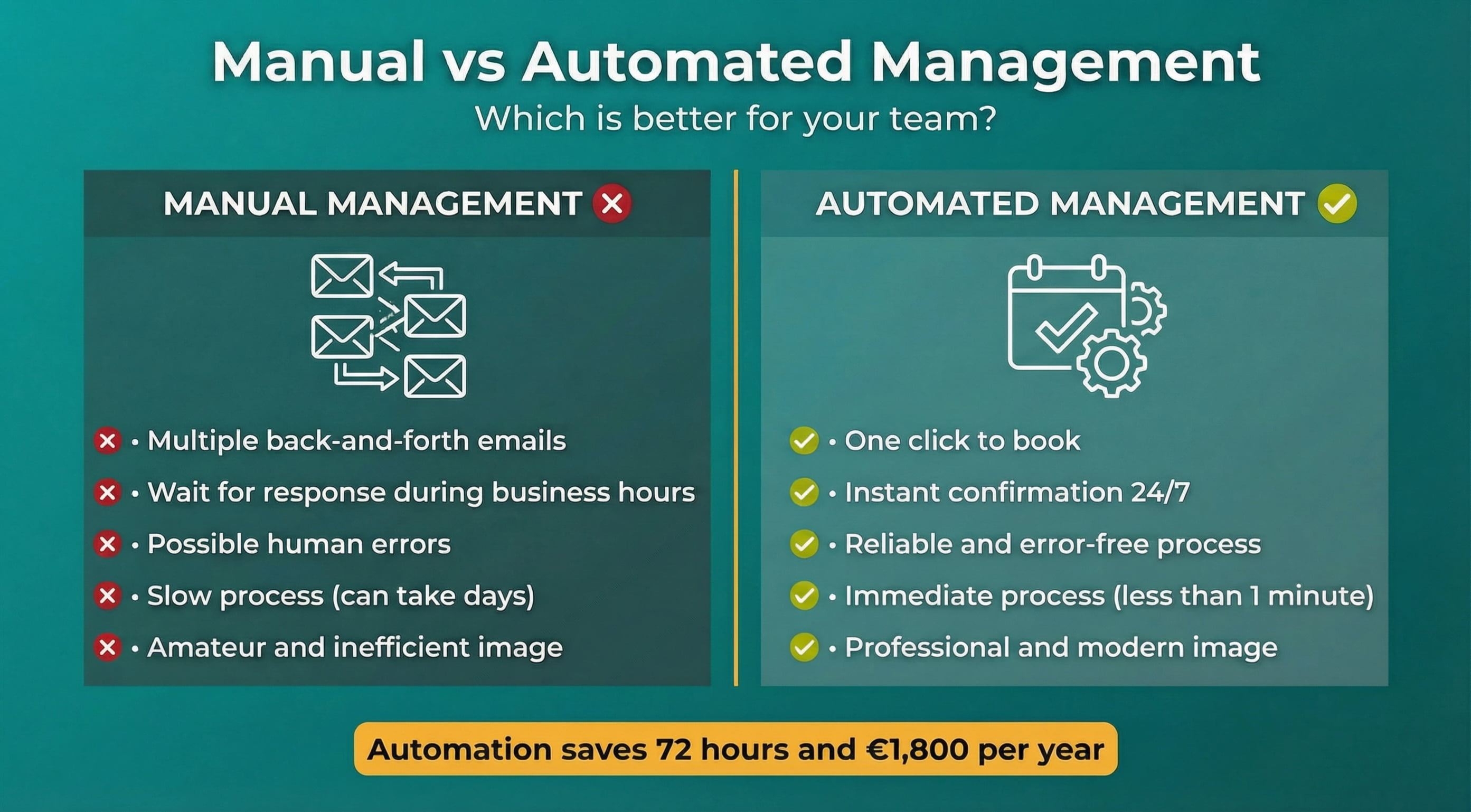
In a competitive market, the ease and professionalism of the booking process is the first real contact with your organization and should be part of your brand and value proposition.
Manual vs. automated management
| Manual Management | Automated Management |
| Multiple emails back and forth | One click to book |
| Wait for response during business hours | Instant confirmation 24/7 |
| Possible human error | Reliable and error-free process |
| Slow processing (can take days) | Immediate processing (less than 1 minute) |
| Amateur and inefficient image | Professional, modern image and respectful of customer time |
Offering a seamless, self-contained booking system is not a technological luxury; it is a statement about how you value your customers' time and the efficiency of your team and your own operations.
Frequently Asked Questions (FAQ) on the cost of manual meeting management
These are the most common questions that come up when analyzing the cost of managing meetings manually.
How much time is actually wasted by scheduling meetings manually?
Manually managing a meeting can consume an average of 12 minutes per appointment. This time includes:
-
coordination mailings,
-
checking availability in calendars,
-
sending confirmations,
-
manual reminders,
-
and rescheduling.
In a small team managing 30 meetings per month, this can easily exceed 70 hours per year spent exclusively on administrative tasks related to customer meeting management.
What is the economic cost of not automating meeting management?
The cost is not only operational, it is financial. For a two-person team, those 70+ hours per year can represent more than €1,800 in lost productivity, considering a conservative business cost per hour.
Add to this:
-
lost business opportunities outside working hours,
-
customers abandoning due to booking friction,
-
impact on customer experience.
Is meeting automation only for large companies?
No. In fact, small teams and freelancers often benefit the most.
In small teams:
-
every hour saved has a direct impact on turnover,
-
every mistake affects reputation more,
-
every missed opportunity weighs more.
Automating appointment scheduling frees up strategic time and creates a scalable structure from the start.
What errors are avoided by automating appointment scheduling?
An automated system almost completely reduces the most common human errors, such as:
-
double bookings,
-
time zone mix-ups,
-
incorrect sending of links,
-
forgotten confirmations or reminders.
This improves the customer experience, protects the professional image and brings consistency to the booking process.
Conclusion: A productivity debt you pay for every day
Manually managing customer meetings is not free. It's a productivity debt your team pays every day in the form of wasted time, opportunity costs, avoidable errors and a professional image that can be compromised. The first step in correcting any inefficiency is to recognize its magnitude.
Now that we've quantified the true cost of not automating meeting management, it's time to crunch your own numbers. How many hours and euros is your team spending each month manually coordinating agendas?
If you want to see how a professional system can eliminate this productivity debt and transform the way your team manages client meetings, we invite you to book a demo and analyze your case in detail.
 Book a live demo with a member of our team now and start making up time from day one.