

You have prepared the programme, found a venue and decided how many people you can accommodate. Now comes a question that is not always easy to answer: how much should you charge for the workshop?
Looking at other workshops can help you understand the options available to your audience. But copying a price without reviewing your costs, expected bookings and what the activity includes could leave you with a full group and an insufficient return.
To price a workshop, calculate your costs, use a realistic estimate of participant numbers and check what happens when you offer different rates. Then compare the result with the value of the experience and the alternatives available to your audience.
Let’s work through an example: a three-hour, in-person photography workshop for a maximum of ten participants.
1. Define what the price includes before calculating it
Two three-hour photography workshops can offer very different experiences.
One might consist of a presentation for twenty people. Another might include practical exercises in a small group, individual photo reviews and materials to continue learning afterwards.
Before setting a price, specify what each participant receives:
| Aspect | Workshop example |
|---|---|
| Duration | Three hours |
| Maximum group size | Ten participants |
| Activity | An introduction followed by guided practice |
| Individual attention | Photo reviews during the workshop |
| Included materials | An exercise guide |
| Required equipment | Each participant brings their own camera |
| What the booking covers | One place for the complete activity |
This helps you calculate the resources required and explain the price through specific details about the experience.
If a material or service is not included, make this clear before registration. Participants should be able to assess the full cost of attending.
If you are still developing the programme, see our guide on how to organise a workshop and manage online registrations.
2. Include the work that happens outside the workshop
The three hours of teaching do not represent all the time needed to organise the activity.
You also need to prepare exercises, check materials, answer questions, publish the information and organise registrations. If you only count the time spent with the group, some of your work goes unpaid.
Separate two types of costs:
- Fixed costs for the workshop: costs you incur even if fewer people attend, such as preparation, teaching and venue hire.
- Costs per participant: costs that increase with each registration, such as individual materials or consumables.
For our workshop, we will use these figures:
| Item | Calculation | Amount |
|---|---|---|
| Preparation and teaching | Five hours in total × €30 | €150 |
| Venue hire | One workshop | €90 |
| Promotion and administration | Amount allocated to this workshop | €40 |
| Fixed costs | €280 | |
| Materials per participant | Guide and consumables | €5 |
Illustrative example. Payment for the instructor’s work is already included in the costs.
To keep the calculation straightforward, we have excluded taxes and payment processing fees. When preparing your actual budget, account for these where applicable and distinguish between the price paid by the participant and the revenue available to cover your costs.
3. Calculate using the places you expect to sell
Your workshop can accommodate ten people, but that does not mean you should calculate the price assuming that every place will sell.
If you only cover your costs when the group is full, each empty place changes the result.
A useful starting formula is:
Break-even price per participant = fixed costs ÷ expected participants + cost per participant
Suppose you plan the workshop around eight registrations:
€280 ÷ 8 + €5 = €40 per participant
With eight people paying €40, you would receive €320. Your costs would also be €320: €280 in fixed costs and €40 for materials.
This covers the costs in the example, including the planned payment for your work. It does not leave an additional amount for contingencies or the business.
If you want the workshop to generate a surplus of €120, the calculation becomes:
Price per participant = (fixed costs + target surplus) ÷ expected participants + cost per participant
(€280 + €120) ÷ 8 + €5 = €55
This gives us a reference price of €55 per person, based on eight registrations.
This is not a recommended price for every photography workshop. It is the result of specific assumptions that you will need to adapt to your own activity.
4. Check what happens if fewer people register
Before publishing the price, look at how the result changes at different occupancy levels.
Keeping the price at €55:
| Participants | Revenue | Total costs | Workshop surplus or shortfall |
|---|---|---|---|
| 5 | €275 | €305 | −€30 |
| 6 | €330 | €310 | €20 |
| 8 | €440 | €320 | €120 |
| 10 | €550 | €330 | €220 |
Total costs: €280 in fixed costs plus €5 per participant. Illustrative figures, excluding taxes and payment processing fees.
At this price, six participants cover the costs included in the example. Eight achieve the target surplus of €120.
This helps you distinguish between three figures:
- Maximum capacity: how many people you can accommodate while maintaining the experience.
- Break-even attendance: how many registrations you need at your chosen rates to cover costs.
- Registration target: how many participants you need to achieve your intended result.
These figures do not have to be the same.
If you set a minimum number of participants for the workshop to go ahead, explain before booking what will happen if that minimum is not reached and when registered participants will be informed.
5. Compare the calculation with your offer and your audience
The calculation helps you understand what you need to charge. The next step is to assess whether the offer is compelling to the people you want to reach.
When reviewing other activities, compare equivalent conditions:
- Duration and content.
- Group size.
- Instructor experience.
- Included materials and equipment.
- Amount of practical work and individual attention.
- Location and format.
A higher price needs an offer that participants can understand. In our example, “a three-hour photography workshop” tells people less than explaining that it includes guided practice, a maximum of ten participants and individual photo reviews.
If the calculated price does not suit your audience, review the format, costs or content. Reducing the price without changing anything else could make the workshop no longer worthwhile for you.
6. Calculate the effect of early bird and group rates
An early bird rate can help you receive bookings sooner and plan the workshop. A group rate can make it easier for several people to sign up together.
However, both reduce revenue per place. Calculate the effect before publishing them.
An early bird booking example
We start with the standard price of €55 and offer four early bird places at €45.
With eight participants, the result changes as follows:
| Registration breakdown | Revenue | Costs | Surplus |
|---|---|---|---|
| Eight places at €55 | €440 | €320 | €120 |
| Four places at €45 and four at €55 | €400 | €320 | €80 |
The early bird rate reduces the surplus by €40. This may be a reasonable decision if securing those first bookings is valuable to you, but it helps to understand the effect.
Set a clear condition: a deadline, a limited number of places or both. Avoid keeping a supposed early bird rate available throughout the entire booking period.
A group rate example
If two people pay €50 each instead of €55, their combined payment falls from €110 to €100.
Materials still cost the same unless there is a genuine saving. Two people registering together still occupy two places.
Before creating a group rate, specify:
- How many people it includes.
- Whether the displayed price is per person or for the whole group.
- How many places the booking uses.
- What happens if one person cancels.
- Whether it can be combined with other rates.
When offering several rates, review the expected total revenue, rather than just the highest price. The number of participants needed to cover costs may change too.
7. Present prices and conditions clearly
The registration page should make it easy to understand how much participation costs and what is included.
For the example above, you could present:
| Rate | Price | What it includes | Condition |
|---|---|---|---|
| Standard | €55 per person | Complete workshop and exercise guide | Subject to availability |
| Early bird | €45 per person | The same content as the standard rate | First four places, until the stated deadline |
Presentation example. On the actual page, display the applicable final price and a specific deadline.
You do not need many pricing options. If there is no clear distinction to explain, a single rate may make the decision easier.
Before opening registration, also check:
- When payment is required.
- Which materials are included.
- What participants need to bring.
- Which cancellation or change conditions apply.
- Whether the price covers one session or the complete programme.
For a multi-session course, make it particularly clear whether registration includes every date. See our guide on how to manage registration for a multi-session course for more detail.
8. Set up pricing options in TuCalendi
Once you have defined the costs, capacity and conditions, you can apply those decisions to the registration page.
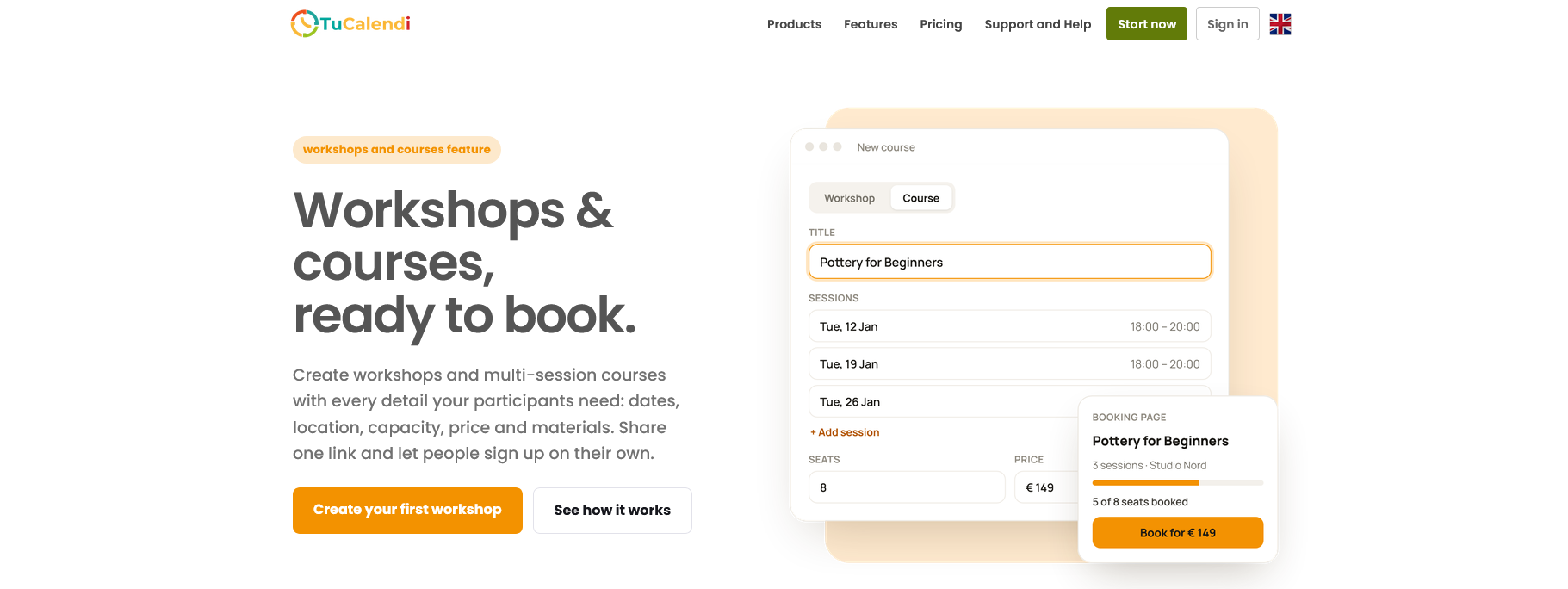
TuCalendi’s Workshops and courses feature lets you offer standard, early bird, group or custom rates, per place or as a package. You can also limit pricing options by date or allocation and accept payments during booking through Stripe or PayPal.
To apply our example:
- 1. Set the workshop capacity to ten participants.
- 2. Add the standard rate.
- 3. Configure the early bird option with its price and limits.
- 4. Explain what each rate includes and what participants need to bring.
- 5. Test the booking process to check the displayed amount and conditions.
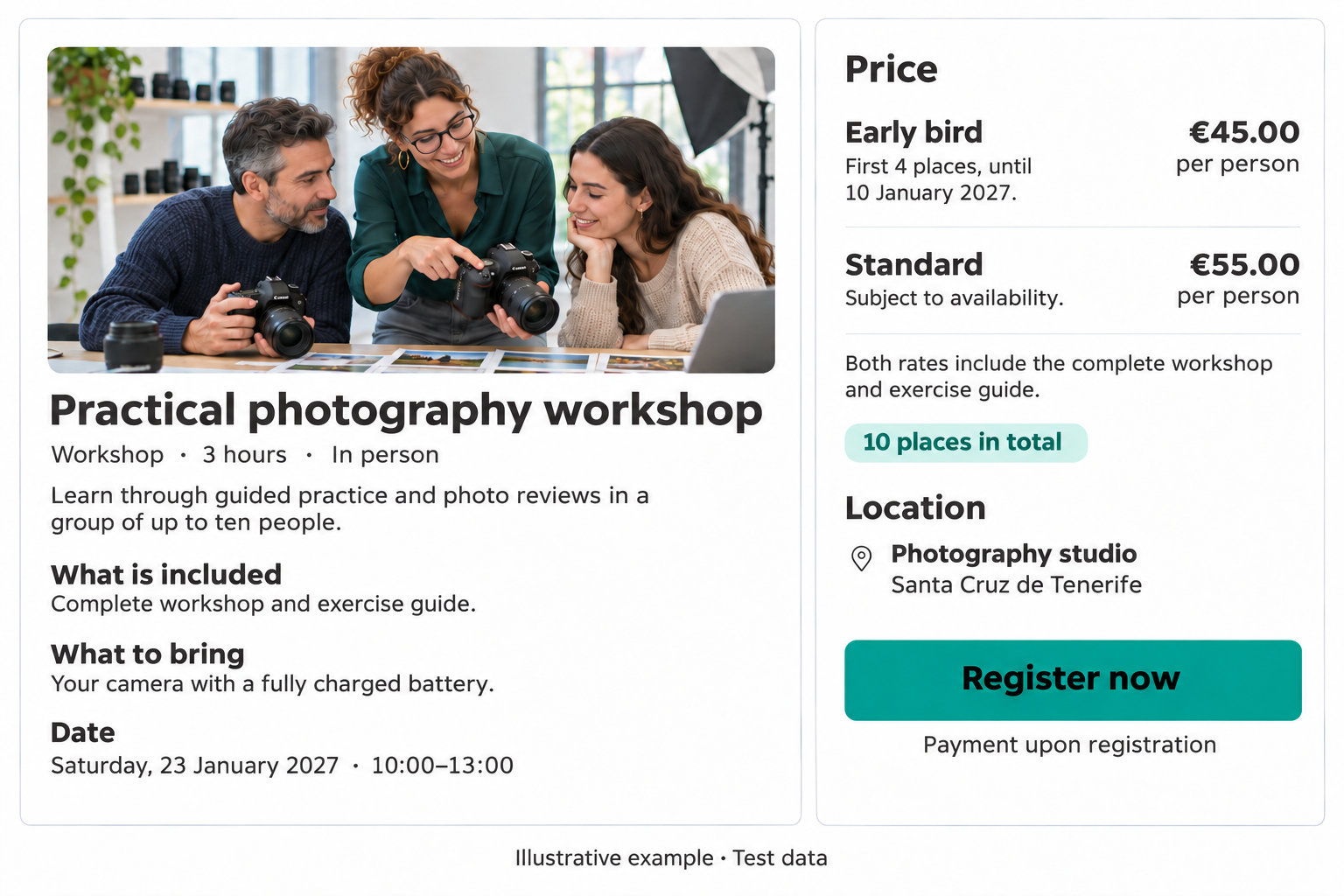
Two rates for the same workshop, with prices and conditions clearly displayed. Illustrative example using test data.
The tool should reflect the decisions you made when planning the activity. In particular, check that the price per person or package is clear and that the limits for each rate are consistent with the overall capacity.
If the group fills up, you can follow the process explained in how to manage course capacity and waiting lists.
A good price should support the experience you promise
Pricing a workshop means deciding what experience you will offer, how many people you can accommodate and what result you need to make the activity worthwhile.
Before publishing, review the scenario with fewer registrations and the effect of discounted rates. This gives you a more useful forecast than assuming that every place will always sell at the standard price.
Would you like to set up pricing and registration for your next workshop? Book a demo with the TuCalendi team, and we will explore how to organise it with you.