

A thirty-minute meeting can involve considerably more than thirty minutes of work. Beforehand, you gather information, prepare questions and review previous conversations. Afterwards, you organise your notes, check agreements and write the follow-up.
Artificial intelligence can help reduce some of that work. But to decide whether it is worth using, you need to compare the time recovered with the effort required to review its output and the cost of the tool.
With Meetfy.ai, you can start with the features you need and expand your usage based on the results: the Basic plan has no monthly subscription fee and works with credits you purchase and use at your own pace. Credits never expire, and you can top up whenever you need to. For teams, Enterprise is available on request.
This article explores where time savings may arise and how to calculate them using an example: recovering 15 net minutes per meeting through preparation, coaching, transcription and analysis.
The time savings in this example are assumptions used to explain the calculation, not measured results from Meetfy.ai. Replace them with your company’s actual figures.
1. Meeting time includes preparation and follow-up
When calculating the effort involved in a meeting, we often focus on its duration. However, there is also work before and after the conversation.
| Stage | Tasks worth measuring |
|---|---|
| Before | Gathering context, reviewing previous notes, and preparing goals and questions |
| During | Holding the conversation and capturing information |
| After | Organising notes, checking agreements, preparing the follow-up and recording next steps |
Some tasks happen simultaneously. Taking notes while listening does not necessarily add minutes to the meeting itself, so you should avoid counting that time twice.
Start by measuring how much time you actually spend preparing for a meeting and working on it afterwards.
2. What do studies say about time savings?
Research has found time savings in certain tasks related to meetings.
Summarising a recorded meeting
In an experiment published by Microsoft in 2023, 60 employees were divided into two groups and asked to summarise a recorded 35-minute meeting they had not attended.
The group using Copilot completed the task in 11 minutes and 13 seconds, compared with 42 minutes and 34 seconds for the group without the tool.
There was also a slight reduction in completeness: the Copilot group captured 11 of the 15 details assessed, compared with 12 in the control group. The result illustrates both the potential time savings and the need to review the output.
Reducing work after meetings
Research published by Zoom involving 688 knowledge workers reported an average saving of 1.6 hours per week on post-meeting tasks, such as preparing recaps, capturing action items and finding information.
The research was commissioned by the provider and relied on self-reported time savings. This is a weekly figure, not a fixed saving per meeting.
These findings relate to other tools and contexts. They provide useful background on AI’s potential, but they do not establish the same savings for Meetfy.ai. To understand its impact on your business, you need to measure your own workflow.
3. Where can Meetfy.ai help?
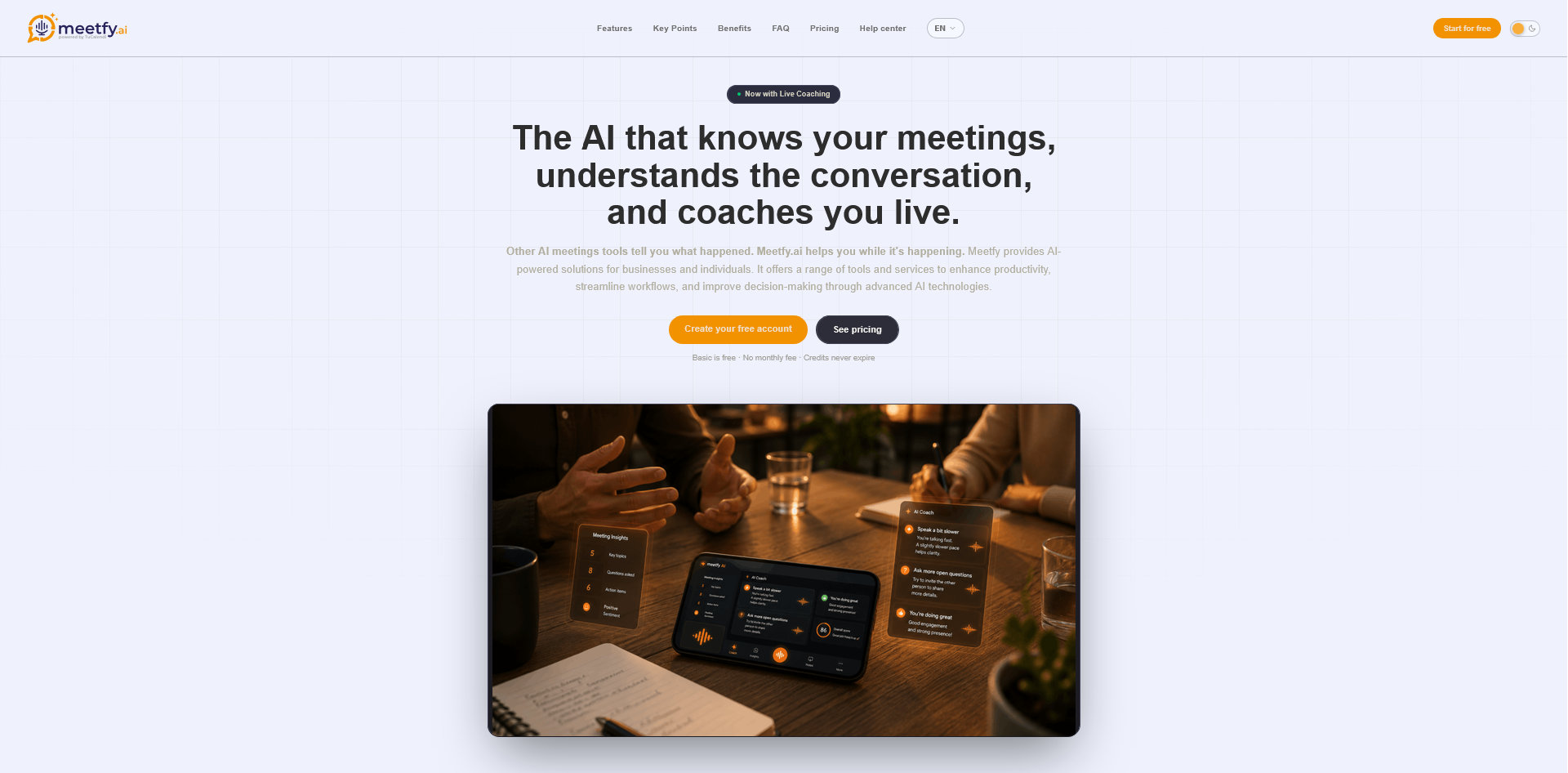
As explained in our introduction to Meetfy.ai, its features cover different stages of a meeting.
Preparing the context
Bringing together goals, questions, the other person’s preferences and outstanding issues helps you enter the conversation with a clear direction.
Our tutorial on how to prepare a sales meeting with AI and Meetfy.ai explains how to organise this information.
The potential saving depends on the information available and how much you need to review or update before using it.
Receiving support during the conversation
Meetfy.ai’s AI coaching provides suggestions during the meeting.
It may help you remember an unanswered question or clarify an issue. That does not necessarily mean the meeting will be shorter: sometimes it is worth spending more time understanding an important need.
Reviewing the meeting and preparing the follow-up
Transcriptions, analyses and summaries can make it easier to retrieve information and review what was discussed.
You still need to check the conclusions and distinguish between a suggestion, an open question and a confirmed commitment. That review is part of the time spent using the tool.
4. Example: recovering 15 net minutes per meeting
Imagine a professional who holds sales meetings and spends additional time preparing for each conversation and sending the follow-up.
For this example, we assume that the conversation itself lasts the same amount of time. The difference comes from these tasks:
| Task | Without AI | With AI, including setup, review and corrections | Time recovered |
|---|---|---|---|
| Preparing context and questions | 12 min | 8 min | 4 min |
| Organising notes and checking agreements | 13 min | 6 min | 7 min |
| Writing the follow-up | 10 min | 6 min | 4 min |
| Total | 35 min | 20 min | 15 min |
The calculation is:
35 minutes using the usual workflow − 20 minutes with AI = a net saving of 15 minutes per meeting.
These 15 minutes are an illustrative assumption. You might recover more time in some meetings, less in others, or none at all. The way to find out is to measure the complete workflow, including review.
5. How much does a 30-minute meeting cost with Meetfy.ai?
Now let’s add the usage cost.
Consider a meeting where you use coaching for thirty minutes, analyse three images, transcribe thirty minutes of audio and run one meeting analysis.
| Feature | Calculation | Credit usage |
|---|---|---|
| Live coaching | 30 minutes × 3 credits | 90 credits |
| Image analysis | 3 images × 5 credits | 15 credits |
| Transcription | 30 minutes × 1 credit | 30 credits |
| Meeting analysis | 1 analysis × 2 credits | 2 credits |
| Total | 137 credits |
The published reference value is approximately €0.012 per credit:
137 credits × €0.012 = €1.644, or approximately €1.64 per meeting.
Preparing the meeting, recording audio and taking photos do not consume credits; analysing the images does. Euro amounts are indicative: the binding price, including applicable taxes, is displayed before purchase and may differ between the app and the dashboard.
You do not need to use every feature in every meeting. This example helps you budget for one specific combination; your actual consumption will depend on how you use the tool.
6. What does this mean for an individual and a team?
Let’s keep three assumptions:
- 15 net minutes recovered per meeting.
- 137 credits used per meeting, at an indicative cost of €1.644.
- €30 per hour as a reference value for working time.
One professional with twenty meetings per month
20 meetings × 15 minutes = 300 minutes: 5 hours per month.
At a value of €30 per hour:
5 hours × €30 = €150 worth of recovered working time.
Credit usage in this scenario would be:
20 × 137 credits = 2,740 credits, equivalent to approximately €32.88.
Five professionals achieving the same result
If each person holds twenty meetings and achieves the same net time saving:
100 meetings × 15 minutes = 1,500 minutes: 25 hours per month.
The full comparison would look like this:
| Item | One professional: 20 meetings | Five professionals: 100 meetings |
|---|---|---|
| Monthly time recovered | 5 hours | 25 hours |
| Estimated value of time at €30/hour | €150 | €750 |
| Total credit usage | 2,740 credits | 13,700 credits |
| Indicative usage cost | €32.88 | €164.40 |
| Value of time minus usage cost | €117.12 | €585.60 |
Costs are calculated using €1.644 per meeting before rounding. The team scenario reflects credit usage only. Any additional implementation or Enterprise setup costs must be included separately.
Do not multiply the saving by every attendee in the same meeting if only one person would otherwise handle preparation and follow-up. Each saving should correspond to work that is actually reduced.
7. Recovered time and money saved are different outcomes
The five hours in the example could be used to prepare proposals, respond to customers or complete other tasks.
That represents recovered working capacity, but it does not mean the business will spend €150 less that month.
It helps to distinguish between:
| Outcome | What it means |
|---|---|
| Recovered working capacity | Time available for other work |
| Actual financial savings | An expense that genuinely decreases |
| Estimated value of time | A reference for comparing effort with the cost of the tool |
For example, actual financial savings could arise if overtime or an outsourced service is reduced. If working hours and spending remain the same, the benefit depends on how the recovered time is used.
The amounts of €117.12 and €585.60 compare the assigned value of time with indicative credit costs. They are neither guaranteed profits nor measured returns from Meetfy.ai.
8. Credits you can use at your own pace
Meetfy.ai’s model lets you start with a specific use case and expand based on the results.
You can purchase credits, use your balance as needed and top up when necessary. You do not have to use up your credits within a particular month.
Before testing the tool, decide which features you want to evaluate. You may need coaching for some conversations and transcription or analysis for others.
Check the current Meetfy.ai pricing details, including storage limits and options for teams.
9. How to measure the results in your business
Choose comparable meetings, such as initial sales conversations of a similar length.
First, record how you normally work. Then test the selected features and measure the complete process.
| Item | What to record |
|---|---|
| Meeting type | Initial conversation, demonstration or follow-up |
| Preparation | Minutes spent before the meeting |
| Duration | Actual conversation time |
| Review and corrections | Time spent checking the output |
| Follow-up | Time spent writing and organising next steps |
| Features used | Coaching, transcription, image analysis or meeting analysis |
| Usage | Credits consumed |
| Quality | Errors, omissions and adjustments required |
| Result | Difference compared with the usual workflow |
Separate initial learning from routine use. The first sessions may take longer, and that effort should also be included in your evaluation.
Assess time savings alongside quality. A faster follow-up loses its value if it contains an incorrect figure or a commitment nobody made.
How much time could your business recover?
Start with a task you can observe: preparing a conversation, reviewing its agreements or writing the follow-up. Measure the complete time involved and compare it with actual credit usage.
Book a meeting with the TuCalendi team. Together, we will review the meetings you want to improve, identify which Meetfy.ai features fit your needs and estimate credit usage based on your activity.
We will show you how to use Meetfy.ai independently or connected to TuCalendi, and how to run a trial that measures recovered time using your own data.