

The first session has already taken place, and there are still places available. Then an enquiry arrives: “I’ve just discovered the course. Can I still sign up?”
Accepting the registration could help another person benefit from the training and fill an available place. But first, you need to check whether they can follow the content, which part of the programme they will receive and how much they should pay.
You can accept participants after a course has started if the content allows it, places are available and you clearly explain the included sessions and conditions. The decision should consider both the person joining and the group already progressing through the programme.
Let’s explore what to check before offering this option, using a four-session course where the first session has already taken place.
1. When does it make sense to let participants join?
Not every course needs to close registration when the first session begins.
A programme with relatively independent sessions may accommodate new participants easily. In other courses, the initial content is essential for understanding what follows.
Before accepting someone, review:
| Question | What you need to assess |
|---|---|
| What has already been covered? | Whether that content is essential for continuing |
| What does the person already know? | Whether they have the necessary knowledge |
| How many sessions remain? | Whether they can still achieve a useful outcome |
| Are places available? | Whether you can maintain the planned capacity and level of support |
| Is additional preparation needed? | What you can provide and which resources it requires |
| How will it affect the group? | Whether you can integrate the person without disrupting progress |
For example, someone with previous experience might join a course whose first session introduced concepts they already understand. Someone without that foundation may need to wait for the next course.
An available place is necessary, but it does not guarantee that the course is suitable for someone joining later.
2. What is the difference between joining late and booking individual sessions?
These options may look similar, but they do not represent the same registration.
- Booking individual sessions: the participant chooses a date offered independently.
- Joining a series already in progress: the participant registers for the remaining dates of an ongoing programme.
In our example, the course has four sessions. One has already taken place, and three remain. The new registration covers those three remaining sessions; it does not mean freely choosing one of them.
If you are still deciding how to offer your activity, see full course or individual sessions: which registration options should you offer?.
3. How late should you accept new registrations?
Rather than deciding each request as it arrives, establish a policy before publishing the course.
You can assess the limit from two perspectives:
Learning requirements. Decide when too much essential content will have been covered for someone to join successfully.
Remaining sessions. Decide how many sessions must remain for joining to be worthwhile.
For a four-session series, you might accept participants while at least three sessions remain. For an activity with independent sessions, joining later may still make sense.
There is no universal minimum. The useful question is: what can someone learn or complete through the sessions they will still receive?
If the answer no longer matches the advertised outcome, revise the description of what late registration includes or direct the person to another course.
4. What price should apply to the remaining sessions?
For a paid course, you need to define how the amount is calculated for someone joining after the start.
One option is proportional pricing based on the number of remaining dates.
Suppose:
| Item | Example |
|---|---|
| Sessions in the original programme | 4 |
| Full-course price | €400 |
| Sessions already completed | 1 |
| Remaining sessions | 3 |
| Proportional price for joining | €300 |
The calculation is:
€400 × 3 ÷ 4 = €300
Illustrative example with the price distributed evenly across the four dates.
Here, the participant pays €300 to join the three remaining sessions. They are not buying all four or automatically receiving access to the previous session.
The proportional price should relate to the dates included in the new registration. Avoid presenting it simply as a discount on the complete course when the participant will receive fewer sessions.
If materials, access to previous content or other services are involved, explain what the amount includes. Do not promise recordings, catch-up sessions or additional resources unless they are included.
5. What should participants see before booking?
The registration page should make it clear that the course is already in progress.
For our four-session example, show:
- A notice that the course has started.
- The date from which the participant can join.
- The number of remaining sessions compared with the original programme.
- Past and upcoming dates.
- The price for joining.
- Required knowledge and included materials.
A clear notice could say:
The course has already started. You can join from 3 December for the three remaining sessions. The price for this registration is €300.
The schedule should support that message. Marking the first session as past helps distinguish the original programme from the dates the new participant will attend.
The price label matters too. If €300 is the total for the three remaining sessions, it should be understood as the price for joining, rather than the price of each session.
An example presentation would be:
Price for joining: €300 per person
Includes the three remaining sessions.
Full programme price: €400.
6. What should you communicate after registration?
The confirmation should reflect the conditions the participant accepted.
Sending the original schedule without clarifying their starting date is not enough. In our example, the message could look like this:
Subject: Your registration for the remaining course sessions is confirmed
Hi Laura,
Your registration is confirmed for the three remaining course sessions:
- 3 December 2026, from 10:00 to 12:00.
- 10 December 2026, from 10:00 to 12:00.
- 17 December 2026, from 10:00 to 12:00.
All times are in the Canary Islands time zone.
Your registration costs €300. The session on 26 November has already taken place and is not included in this registration.
Before the next session, please review the preparation instructions we have provided. If you have any questions, reply to this email.
Thank you,
The course team
Example template: adapt the dates and conditions, and send it once registration is confirmed.
If you have agreed on preparation work, specify what the participant should do before attending. If no preparation is needed, say so too.
7. Which options does TuCalendi offer for a series in progress?
In TuCalendi’s Workshops and courses feature, you can configure the activity as a series, where one registration covers all dates, and enable the option to let participants join a series already in progress.
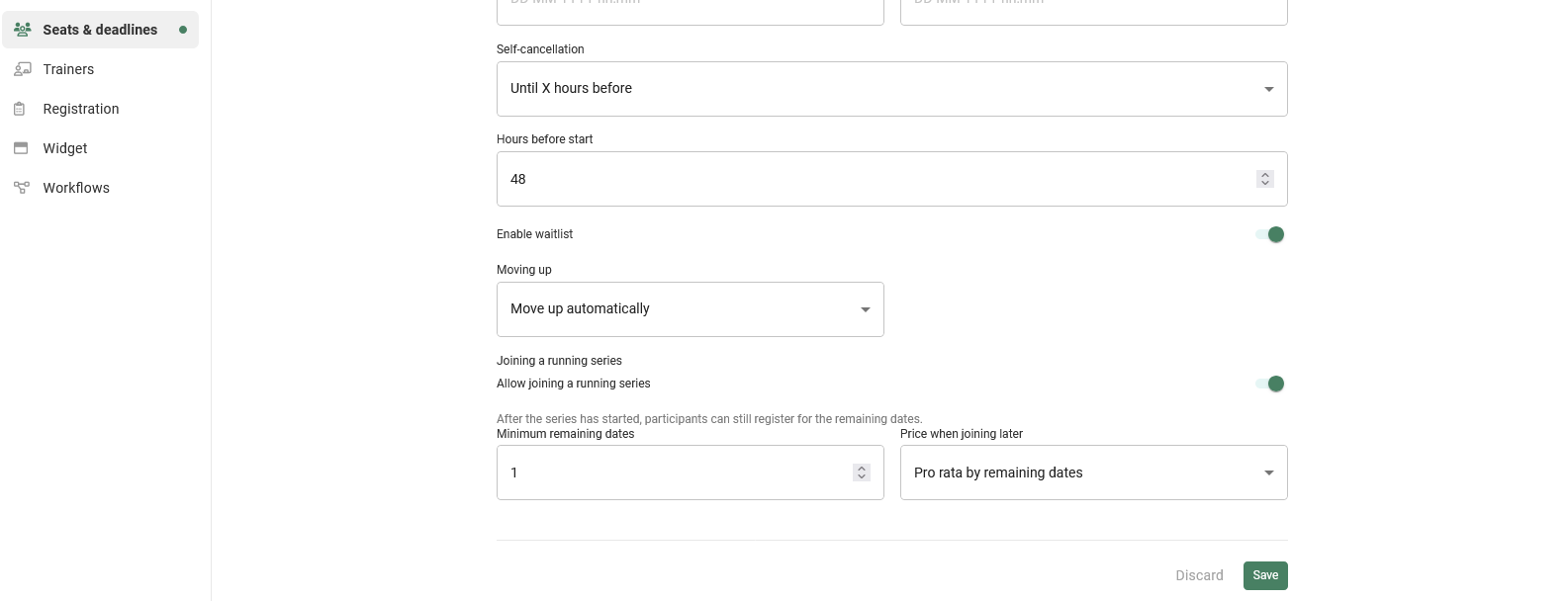
Within these settings, you can configure:
| Setting | Purpose |
|---|---|
| Allow participants to join a series in progress | Enable registration after the programme has started |
| Minimum remaining dates | Set how many dates must remain to accept a new registration |
| Price when joining later | Configure proportional pricing based on the remaining dates |
In the example shown, the widget states that the course has already started, displays the next joining date and indicates that three of the four sessions remain.
It also distinguishes the past date in the schedule and displays the proportional amount alongside an explanation of the remaining sessions.

Registration includes the three remaining sessions. Illustrative example using test data.
Before publishing, review the complete process:
- 1. Check that joining a series in progress is enabled.
- 2. Set the minimum remaining dates according to the content.
- 3. Review the selected pricing option.
- 4. Check the notice, schedule and amount participants will see.
- 5. Verify that the description and confirmation explain what registration includes.
If the activity is full, joining also depends on a place becoming available. See our guide on how to manage course capacity and waiting lists for more detail.
Joining later should still be worthwhile
Accepting registrations after the start can be useful when the person can still benefit from the programme and the group can accommodate them appropriately.
The key is to define how late participants can join and clearly show what remains. The remaining sessions, requirements and price should all communicate the same offer.
Would you like to let participants join courses that have already started? Book a demo with the TuCalendi team, and we will explore how to configure this option with you.