

A course with six dates can work in very different ways. Each session might prepare participants for the next, making it important for the group to follow the whole programme. Or each session might cover an independent technique, allowing someone to book only the one that interests them.
The difference affects what participants are buying, how you organise places and what information you need to display before booking.
Offer full-course registration when the sessions form a connected programme. Allow individual date bookings when each session can be enjoyed independently. If you want to accept participants after the course begins, also decide what they need to join and which sessions their registration will include.
Let’s explore what each option means and how to choose the right one for your activity.
1. What is the difference between booking a series and individual dates?
The first decision is what one registration covers.
| Aspect | Full course or series | Individual dates |
|---|---|---|
| What the participant books | All dates in the programme | One specific date |
| What they need to check before registering | The full schedule and continuity between sessions | The content and conditions of the selected session |
| How learning is structured | A programme that can progress from one session to the next | An experience that can be enjoyed independently |
| Example | A six-session introductory embroidery course | Independent workshops covering different embroidery techniques |
Publishing several dates does not, by itself, explain how the activity is booked.
The page should explicitly state whether one registration includes every session or only the selected date. This helps prevent someone from booking what they believe is a single class when they are actually registering for the full programme.
2. When does full-course registration make sense?
A series works well when continuity is part of the experience.
Imagine a six-session introductory embroidery course. The first session covers materials and basic stitches. Participants then combine techniques, develop a project and finish their piece.
One registration for the entire programme lets you present that learning journey as a whole.
It may be suitable when:
- Sessions require knowledge developed in earlier classes.
- Each participant works on a project throughout the course.
- You need to plan materials for the complete programme.
- A consistent group makes the activities easier to organise.
- The advertised outcome requires several sessions to achieve.
In this case, display every date before booking. Someone may be interested in the content but unable to attend the proposed schedule.
A simple description could be:
Registration includes all six course sessions. Check the full schedule before booking. We will work progressively on an embroidery project.
Also explain what happens if someone misses a session. Do not promise catch-up classes, additional materials or individual support unless they are part of your offer.
If you have already chosen this option, see our guide on how to manage registration for a multi-session course.
3. When should you allow individual session bookings?
Individual dates work well when each session offers an activity that can be completed without attending previous sessions.
For example, a studio could offer one workshop on embroidered lettering, another on floral designs and another on decorative clothing repairs. They share a theme, but each has its own objective.
Participants choose the date and content that interest them.
This option may be suitable when:
- Each session has its own outcome.
- There is no required order.
- Participants want to try an activity before committing to more dates.
- Materials or preparation vary between sessions.
- You want to offer one-off activities within a wider programme.
The description could say:
Each date is booked separately. Choose the workshop that interests you and check its materials and requirements. You do not need to have attended the other dates.
Check that the sessions genuinely work independently. If one requires a particular skill, make this clear even if it can be booked separately.
Being able to book a date independently does not mean the activity is suitable for every level.
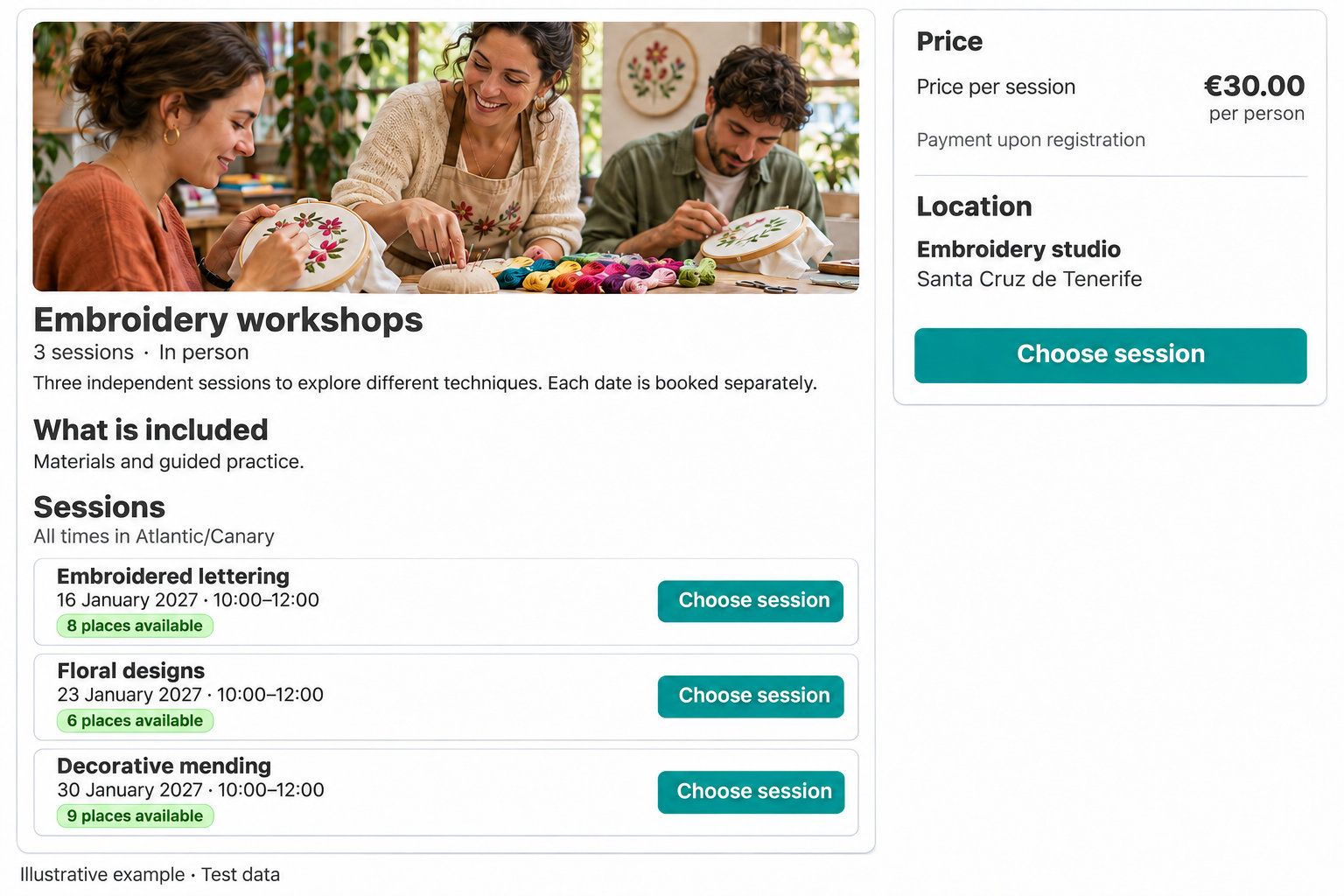
Each date is booked independently. Illustrative example using test data.
4. What should you check before choosing a booking option?
Flexibility is useful when you can maintain the experience you advertise.
Before deciding, answer these questions:
| Question | What it helps you decide |
|---|---|
| Can someone benefit from the third session without attending the first two? | Whether dates can work independently |
| Does the promised outcome require completing the whole programme? | Whether full-course registration is more appropriate |
| Does each session require different materials? | What information and preparation each booking needs |
| Does the group need to progress at the same pace? | How much continuity the course requires |
| What would someone joining later need to know? | Whether you can accept participants after the course begins |
You can also maintain separate offers: a progressive course alongside independent introductory workshops.
You do not need to turn a complete programme into individual sessions to accommodate every preference. Sometimes, a taster workshop lets people discover your offer without changing how the course works.
5. What happens if someone wants to register after the course has started?
Allowing people to join after the start is a separate decision from offering individual date bookings.
For a series, you can decide whether to accept participants once the course has begun. Their registration then covers the remaining dates, subject to the conditions you have established.
Allowing participants to join later does not turn the course into a collection of individual sessions.
Before offering this option, check:
- Whether the person can follow the upcoming sessions.
- What knowledge or preparation they need.
- How many dates must remain for joining to make sense.
- Whether places are available.
- What information they need about content already covered.
In our embroidery course, someone who already knows the basic stitches might be able to join after the first session. If the group is finishing an advanced project, offering the next course may be more appropriate.
An available place does not, by itself, settle that decision.
What should you explain about the price for joining later?
For a paid course with proportional pricing, clearly show which dates the new registration covers and the corresponding amount.
As an illustrative example, a six-session series priced at €180 has an equivalent value of €30 per date. If four sessions remain and the price is calculated proportionally to the number of remaining dates:
€180 × 4 ÷ 6 = €120
This example gives each session equal weight in the calculation. It does not mean every course should use this pricing approach or that an individual session would necessarily be sold for €30.
Participants should understand the price and what it includes before booking.
6. What information belongs on the registration page?
The chosen booking option should be reflected in how you present the activity.
| Information | When booking the series | When booking individual dates |
|---|---|---|
| Registration coverage | All dates included in the programme | The selected date |
| Schedule | Every course session | Date and time of the selected session |
| Content | The programme’s progression and outcome | The objective of that session |
| Requirements | Level needed to follow the course | Knowledge required for that session |
| Price | Amount for the series | Amount for the selected date |
| Joining after the start | Whether it is allowed and what it includes | Booking conditions for upcoming dates |
Avoid ambiguous phrases such as “Book your class” if registration covers the entire programme.
For a series that has already started, an example message could be:
You can join the four remaining sessions. Check the dates and required knowledge before booking. The displayed price covers your registration for those remaining sessions.
Adapt the message to the course’s actual availability and conditions. Participants should not have to work them out from the calendar or price alone.
7. Which options can you configure in TuCalendi?
In TuCalendi’s Workshops and courses feature, the capacity and booking deadlines settings let you choose between two booking types:
- Series: one registration covers all dates.
- Individual dates: each date is booked separately.
This choice determines how you offer the activity. They are two configuration options; it does not mean participants can automatically choose between both within the same course.
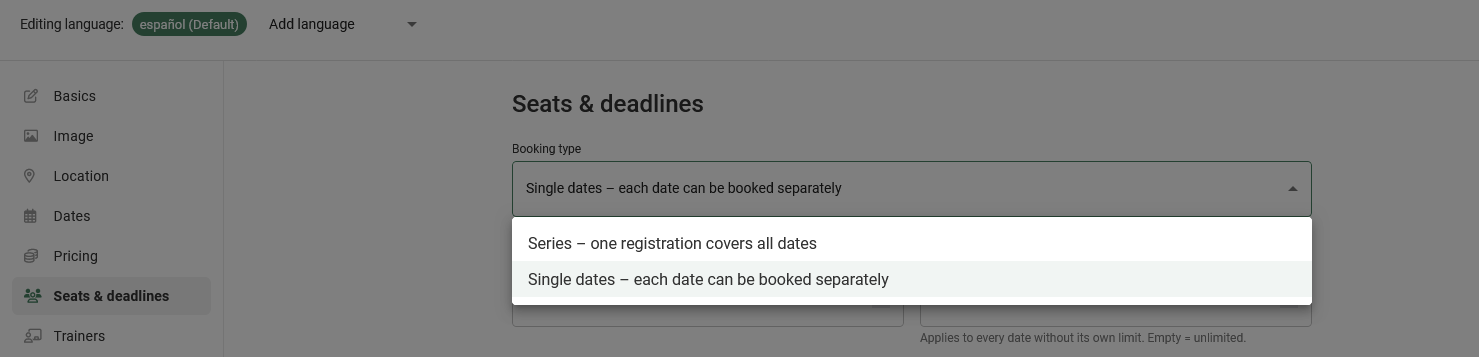
If you choose a series, you can also enable the option to let participants join a series that is already in progress.
This allows registration for the remaining dates after the programme has begun. You can configure:
| Setting | What it determines |
|---|---|
| Allow participants to join a series in progress | Whether registration is possible after the course begins |
| Minimum remaining dates | How many dates must remain to allow registration |
| Price when joining later | How the registration price is applied, including the option to calculate it proportionally to the remaining dates |
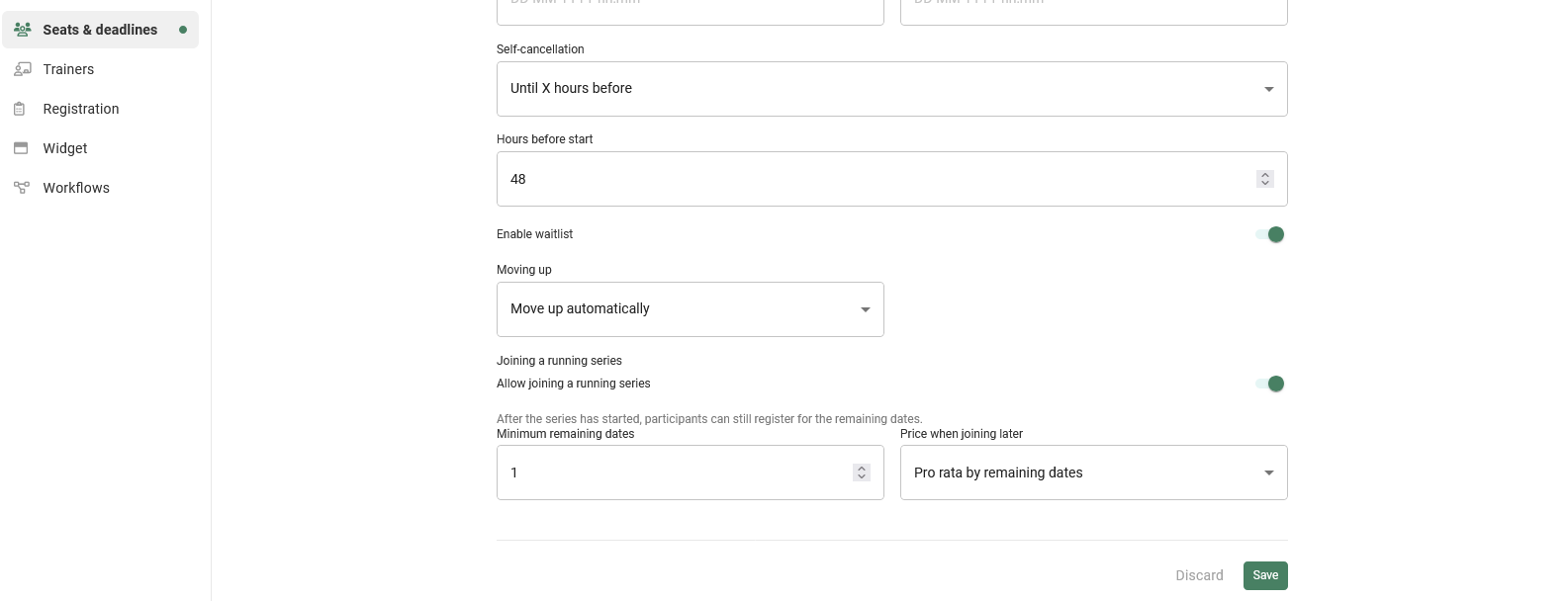
Before publishing, review the result from the participant’s perspective: what they can book, which dates are included and what price is displayed.
Also check that the course description matches the configuration. If you advertise registration for the complete programme, the page should not present its dates as independent workshops.
For help organising capacity and requests once the activity is full, see our guide on how to manage course capacity and waiting lists.
The registration option should fit what you teach
A progressive programme, an independent session and joining a course after it has started meet different needs.
Choosing the right option helps you explain the activity and organise places consistently. For participants, the decision should be clear: what they are booking, whether it suits them and what the price includes.
Would you like to set up registration options for your next course? Book a demo with the TuCalendi team, and we will explore how to configure them with you.