

Although we sometimes overlook the work involved, a sales meeting starts before the customer joins and continues after you say goodbye. You need to understand their situation, prepare questions, listen to their needs and turn the conversation into a concrete next step.
When a team handles several conversations a day, keeping each opportunity moving requires organisation. An unanswered question can get buried in notes, a suggestion can be mistaken for a decision, and a second meeting can start by repeating information the customer has already shared.
AI for sales teams can help prepare the context, offer support during the conversation and make the subsequent review easier. Its usefulness depends on how it fits into the workflow: what information it receives, how its output is checked and what the team does with it.
Meetfy.ai brings together features to support this process. It is a product within the TuCalendi ecosystem that you can use independently or connected to TuCalendi for scheduling.
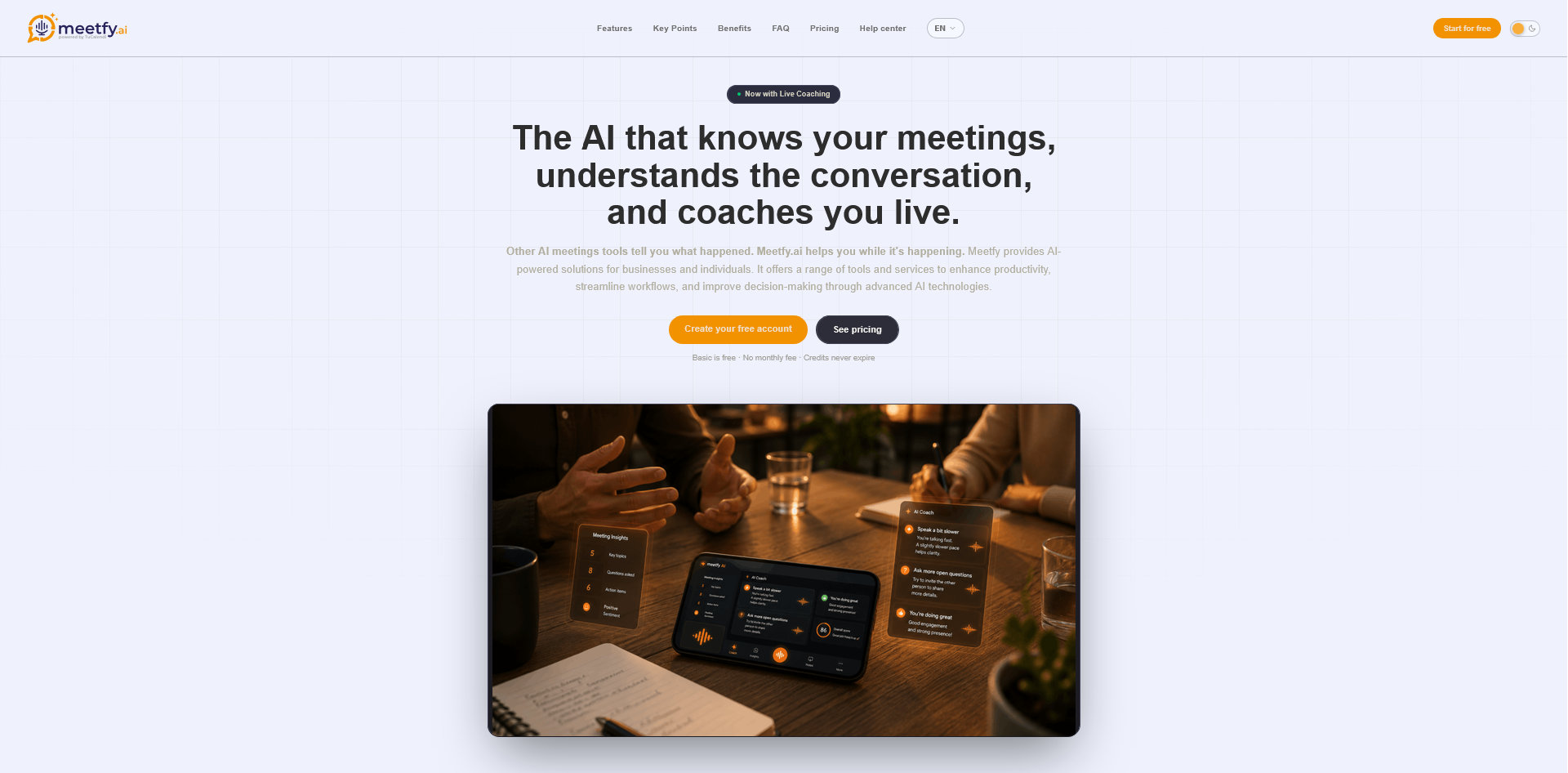
This article explores how to apply it to a sales opportunity, from preparing for the first meeting to following up afterwards.
1. Where AI can help in the sales process
A sales team’s work combines information, conversation and decisions. AI can support each part, while people remain responsible for interpreting needs and agreeing on commitments.
| Stage | What the team needs | Potential AI support |
|---|---|---|
| Before the meeting | Relevant context and clear objectives | Organise available information and prepare for the conversation |
| During | Listen and explore what matters | Offer suggestions and highlight points worth clarifying |
| Afterwards | Understand what was agreed | Support the review with transcriptions, summaries and analyses |
| Before the next meeting | Continue the opportunity with context | Revisit previous discussions and outstanding questions |
The aim is to keep useful information available throughout the process, without relying entirely on the memory of whoever attended the meeting.
2. Before: prepare a conversation with a clear direction
Useful preparation should help you answer specific questions:
- What do we know about the customer, and what still needs confirming?
- What do they want to resolve in this meeting?
- What do we need to understand before presenting a solution?
- What would be a reasonable outcome by the end?
With Meetfy.ai, you can prepare information about the person you will be meeting, their preferences and communication style, the meeting objectives and topics that need particular attention.
You can also record potential positive or negative triggers: subjects that may generate interest, concern or resistance and deserve careful handling.
Separate facts, assumptions and questions
Preparation loses its value when an assumption is treated as a fact.
For example, knowing that a company is expanding its team does not prove it needs a different tool. It may be a useful point to explore, but you need to confirm it during the conversation.
A simple way to prepare is to separate:
| Information type | Example |
|---|---|
| Known fact | The customer has requested a demonstration for their team |
| Assumption | Their current process may make coordination difficult |
| Question to confirm | How do you currently organise meetings, and where do difficulties arise? |
If you record preferences or aspects of someone’s communication style, use relevant information you know and can verify. An initial impression should not become a label attached to that person.
Our tutorial on how to prepare a sales meeting with AI and Meetfy.ai explains how to organise this context step by step.
3. During: use coaching to listen and explore
In a sales conversation, you need to listen, interpret, respond and remember what to ask. AI coaching can provide support while you hold the meeting.
Meetfy.ai lets you receive suggestions during the conversation, on screen or through headphones. It may help you identify a point that still needs explaining.
Imagine the customer says:
“Our main problem is that some requests take too long to reach the right person.”
Before presenting a feature, it would help to understand the process:
- How do those requests arrive?
- Who decides which person they are assigned to?
- Where does the delay occur?
- What consequences does it have for the team or the customer?
Support during the meeting can help you remember one of these questions or explore an incomplete answer.
Suggestions still need sales judgement
Not every suggestion will fit the moment. If the customer is explaining an important concern, continuing to listen may be the best response.
The salesperson decides what to use, when to ask and when to give the other person space. They also need to check product information before making commitments about features, prices or terms.
Our guide to AI coaching in meetings with Meetfy.ai explains how it works.
4. Afterwards: distinguish discussion from agreement
A meeting can end with interest on both sides and still leave uncertainty about what happens next.
Transcriptions, summaries and analyses help you review the conversation. The important step is identifying what has been confirmed and what remains open.
For example, these two statements have different implications:
"We could consider a trial with the team."
"We will run a trial with three people starting on Monday."
The first expresses a possibility. The second contains a more specific commitment. Before preparing the follow-up, check which one accurately reflects the conversation.
What to review before writing to the customer
| Element | What to check |
|---|---|
| Need | What problem the customer described in their own words |
| Priority | Why they want to address it and how important it is |
| Questions | What remains unresolved |
| Commitments | What each party agreed to do |
| Owners | Who is responsible for each action |
| Dates | Which deadlines were confirmed |
| Next step | What needs to happen for the opportunity to progress |
If information is missing or unclear, you can confirm it with the customer. Asking is preferable to presenting an interpretation as an agreement.
Meetfy.ai provides material for this review; the team checks the conclusions and prepares the follow-up.
5. Practical example: from a first meeting to a next step
Imagine a company that wants to improve how it distributes meeting requests across its sales team.
It has booked a demonstration and mentioned that its current process requires too much manual intervention.
Before the meeting
The person responsible prepares the following in Meetfy.ai:
- Known information about the company and the contact.
- The objective of understanding how requests are handled.
- Questions about volume, assignment and difficulties.
- Requirements that still need confirming.
- Topics that may need a more detailed explanation.
The preparation should help establish whether there is a need the solution can meet.
During the conversation
The customer explains that requests arrive through several channels and that one person reviews them before assigning them.
The salesperson explores the process and discovers that the challenge goes beyond booking a time: the company also needs to identify the right meeting type for each request.
Coaching can suggest questions to clarify this requirement. The salesperson decides which ones to use and checks their understanding with the customer.
After the meeting
Reviewing the conversation helps separate four elements:
| Element | Outcome in this example |
|---|---|
| Confirmed need | Reduce manual intervention when directing requests |
| Requirement to review | What information needs collecting before offering a meeting |
| Provider’s action | Prepare a demonstration focused on that workflow |
| Customer’s action | Share the current assignment criteria |
Only actions accepted by both parties should be recorded as commitments.
Using that information, the salesperson could write a follow-up like this:
"Hi Laura,
Thank you for explaining how you currently handle requests.
As discussed, you want to reduce manual review and direct each request to the appropriate meeting type.
We will prepare a demonstration focused on that workflow. As agreed, you will share the criteria you currently use to assign requests.
We still need to confirm what information you want to collect before the booking. We can review that together in our next meeting.
If anything here does not accurately reflect our conversation, please let us know so we can correct it."
This is an illustrative example. The content and commitments should be adapted to each actual conversation.
6. Between meetings: pick up the context without starting again
A sales opportunity can develop over several weeks and involve multiple meetings. Before continuing the conversation, it helps to review:
- What need was identified.
- What new information the customer shared.
- Which objections or questions remain open.
- Which actions have been completed.
- What has changed since the previous meeting.
Available recordings, transcriptions and analyses can help recover that context without reconstructing it from scattered memories.
When several team members are involved, this information can also support a handover. However, the person taking over still needs to check what is current and what remains outstanding.
Maintain a clear place to record the status of each sales opportunity, including owners and next steps. Meeting material can support those updates.
7. How TuCalendi and Meetfy.ai work together
TuCalendi helps organise meeting bookings. Meetfy.ai extends the process with preparation, support during the conversation and post-meeting review.
Meetfy.ai is a separate tool within the TuCalendi ecosystem. You can use it even if you are not a TuCalendi user.
If you use both products, you can view your TuCalendi bookings in the Meetfy.ai app. The TuCalendi dashboard also includes an AI Centre where meeting recordings, transcriptions and analyses are displayed.
This connects appointment scheduling with the work you do around each conversation.
To learn more about the product, read what Meetfy.ai is and why we developed it.
8. How to evaluate its usefulness in a sales team
Start with a group of comparable meetings, such as initial discovery calls or demonstrations of the same service.
Before the trial, decide what you want to improve and how you will assess it.
| Area | What to observe |
|---|---|
| Preparation | Whether objectives and questions are clear before the meeting |
| Understanding | Whether the need is identified and assumptions are checked |
| Follow-up | Whether it accurately reflects the conversation |
| Next steps | Whether it includes confirmed actions and owners |
| Continuity | Whether the next meeting picks up outstanding topics |
| Time | How long preparation, review and follow-up take |
| Quality | What errors, omissions or corrections arise |
| Cost | Which features are used and how many credits they consume |
Our article on how much time AI can save you on meetings includes a numerical example comparing recovered time with credit usage.
Measure results without attributing everything to AI
When an opportunity progresses, many factors may contribute: the customer’s need, budget, proposal, timing or the salesperson’s experience.
It is therefore more useful to start by observing specific process improvements: a more accurate follow-up, fewer details awaiting confirmation or better-organised preparation.
The first sessions also involve learning. Include that effort and the time spent reviewing results in your evaluation.
9. A shared method helps the team use the tool effectively
Every salesperson has their own style, but a team needs some common standards.
You can agree on a minimum preparation structure, what to review after each meeting and how to record the next step. This makes it easier to assess what Meetfy.ai contributes and where the process needs adjusting.
A starting routine could be:
- Prepare the context and define the meeting objective.
- Select the features that make sense for that meeting.
- Use suggestions thoughtfully during the conversation.
- Review the output and confirm commitments.
- Update the follow-up and prepare for the next meeting.
If you plan to record or transcribe, also agree on how to inform participants and manage access and retention in line with your policies and applicable requirements.
The value comes from using the information collected to maintain continuity in the customer relationship.
Discover how to apply Meetfy.ai to your sales meetings
Start with one part of the process you want to improve: arriving with more context, exploring needs during the conversation or preparing a follow-up that clearly reflects what was agreed.
Book a meeting with the TuCalendi team to discuss your situation and discover how to use Meetfy.ai independently or connected to TuCalendi.
We will show you the features that fit your meetings and how to run a trial to assess their usefulness in your team’s day-to-day work.