

Booking a meeting is just the beginning. You still need to prepare, listen carefully and follow through on what was discussed. TuCalendi and Meetfy.ai connect these stages within one ecosystem: TuCalendi automates scheduling, while Meetfy.ai brings artificial intelligence to the work before, during and after each meeting.
This combination addresses an everyday need. Finding an available time solves the coordination challenge, but the work that gives the meeting its purpose remains: understanding why you are meeting, identifying what needs resolving and checking what you have agreed.
That is why we developed Meetfy.ai: to expand the TuCalendi ecosystem and offer a more complete solution around meetings.
TuCalendi organises the meeting. Meetfy.ai helps you prepare, participate and move forward afterwards. You choose the features you need in each situation.
1. Why connect the different stages of a meeting?
In many businesses, scheduling a meeting and working with its content are separate processes.
The booking is in one tool, the objectives in a document, the notes in a notebook and the agreements in an email. Before the next meeting, someone has to bring that information together again.
Working with an ecosystem that covers the different stages helps maintain continuity:
| Stage | What you need to address | Tool |
|---|---|---|
| Booking | Find a suitable time and organise the meeting | TuCalendi |
| Preparation | Define objectives, questions and context | Meetfy.ai |
| Conversation | Listen and receive support when needed | Meetfy.ai |
| Review | Revisit the discussion through transcriptions, summaries and analyses | Meetfy.ai |
| Continuity | Check agreements and prepare for the next meeting | The professional, supported by both tools |
The value comes from each stage supporting the next. A well-organised booking leaves room to prepare, clear preparation helps guide the conversation, and a subsequent review helps you decide how to continue.
2. TuCalendi: automate meeting bookings
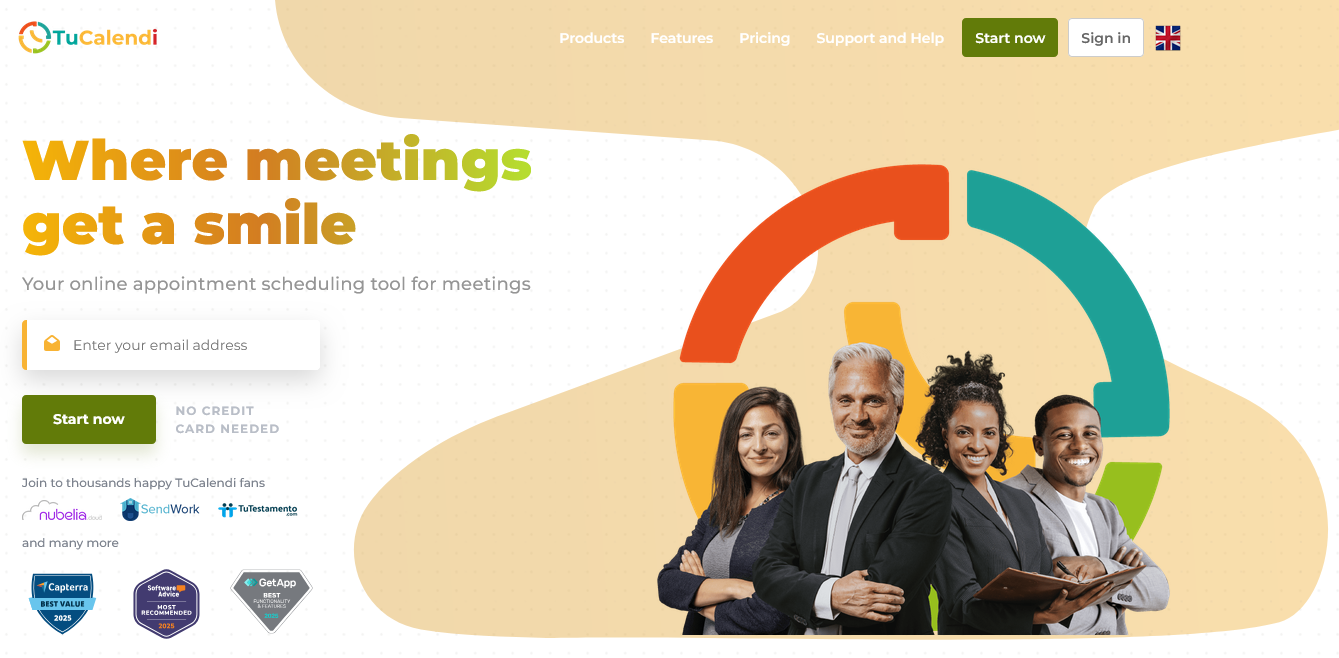
TuCalendi handles the coordination before the meeting.
You can share a booking link or embed a widget on your website so the other person can view available times and book a meeting. Synchronisation with connected calendars helps manage availability, while confirmations and reminders automate part of the communication.
Depending on your needs and configuration, you can organise:
- Meeting types and their duration.
- Available hours and buffers between appointments.
- The minimum notice required to book.
- Questions in the booking form.
- Confirmations and reminders.
These options help define how you want to accept meetings and what information you need beforehand.
Preparation starts with a well-planned booking
An initial thirty-minute consultation may need a different setup from a demonstration or an advisory session.
Defining the meeting type and asking appropriate questions helps you understand the reason for the appointment.
TuCalendi’s smart routing forms can also help collect information and direct the person to the appropriate meeting type.
Learn more about this part of the process on the TuCalendi online scheduling page.
3. Meetfy.ai: before, during and after the conversation
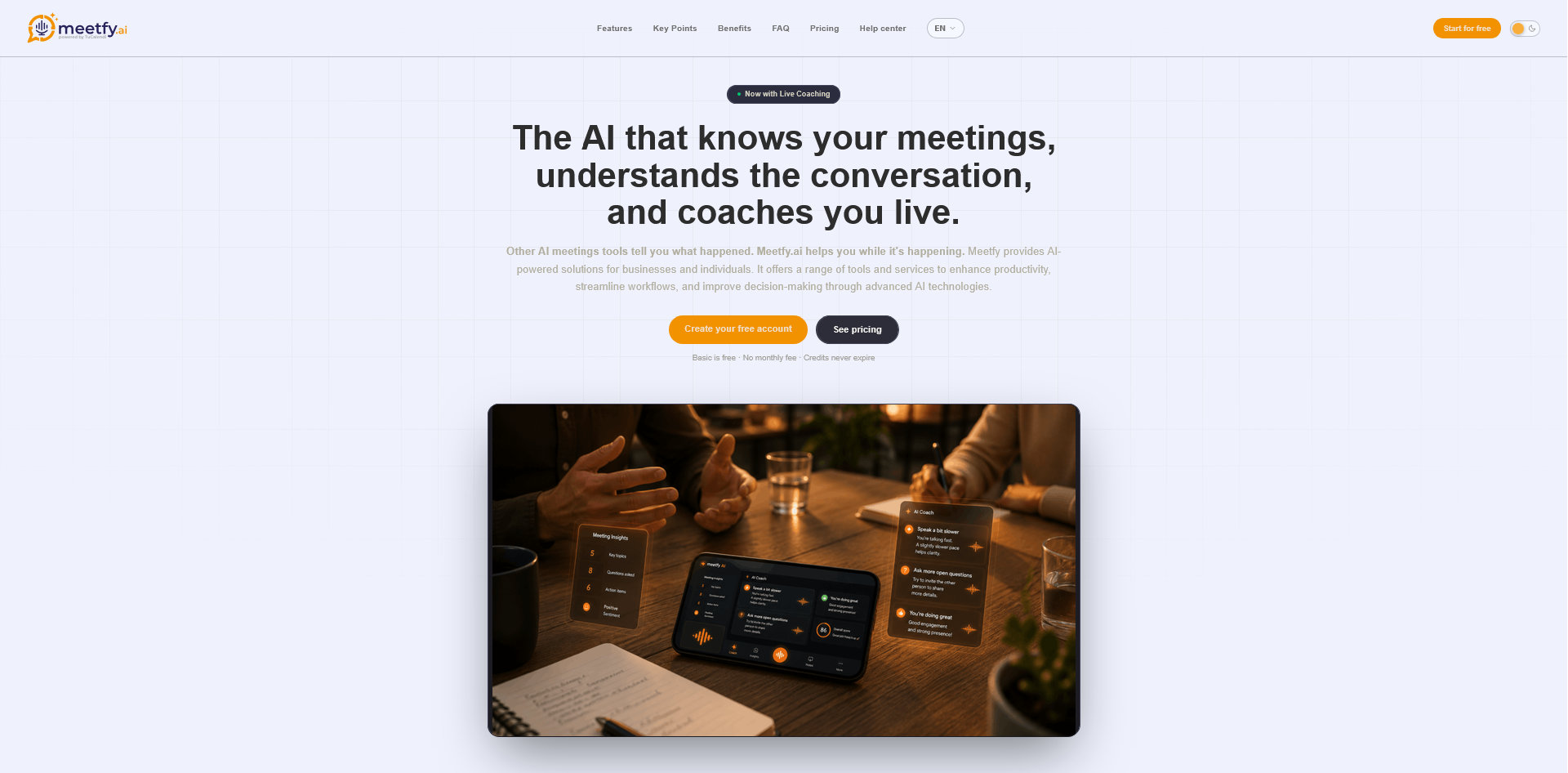
Once the meeting is scheduled, the focus changes: how will you prepare, conduct the conversation and use what was discussed?
Meetfy.ai brings together preparation, live coaching and post-meeting review features. Its approach can be summed up in three words:
Prepare - Listen - Advance.
You can provide context before the meeting and receive suggestions during the conversation, on screen or through headphones. Afterwards, summaries and other review features help you revisit the content.
Each meeting may call for a different combination. You might need detailed preparation for a negotiation, coaching during a particular conversation or a recording to review afterwards.
If you are new to the product, start with our article on what Meetfy.ai is and why we developed it.
4. Before: arrive with context and a purpose
Having a meeting in your calendar does not mean you are prepared for it.
Before starting, it helps to know who you will be speaking to, what you need to understand and what outcome would be reasonable.
In Meetfy.ai, you can prepare information such as:
- Background on the person you will be meeting.
- Meeting objectives.
- Questions and outstanding topics.
- Preferences and communication styles you are aware of.
- Subjects that need particular attention.
- Potential objections and points you want to cover.
Preparation also helps distinguish what you know from what you still need to confirm.
For example, if someone books a consultation to learn about a service, you still need to understand the problem they want to solve, how they currently work and what they expect from the conversation.
TuCalendi helps get the meeting organised. Meetfy.ai helps you prepare what you want to address when the time comes.
Our tutorial on how to prepare a sales meeting with AI and Meetfy.ai shows a practical application of this stage.
5. During: listen with support and use your judgement
The conversation is where you compare your preparation with the actual situation.
An unfamiliar need, an unexpected concern or a question may change the direction of the meeting. Listening remains essential.
Meetfy.ai’s coaching offers support during the conversation. It can suggest ways to explore a point or remind you of a topic that has not yet been addressed.
The professional decides which suggestions to use and when. If the other person is explaining something important, letting them finish may be more useful than introducing another question.
Preparation provides direction; listening helps you adjust
Imagine a consulting session planned to review a project. At the start, the customer explains that their priorities have changed.
The initial objective remains a reference point, but the conversation needs to adapt. AI support can assist with that adjustment; the professional remains responsible for deciding how to guide the meeting.
Our guide to AI coaching in meetings with Meetfy.ai explains this approach.
6. After: follow through on the conversation
When a meeting ends, you need to understand what has been resolved and what requires further work.
Recordings, transcriptions, summaries and analyses can help you retrieve information and review the content. From there, it is worth checking:
| Question | Why it matters |
|---|---|
| What has been clarified? | Update your understanding of the situation |
| What remains open? | Identify outstanding questions or decisions |
| What was agreed? | Distinguish commitments from possibilities |
| Who will do what? | Confirm responsibilities |
| Is there a specific date? | Check agreed deadlines |
| Would another meeting be useful? | Decide how to continue |
Review matters because a proposal is not a decision, and a possibility is not a commitment.
Once you have checked the information, you can prepare the follow-up and, where appropriate, organise another meeting with TuCalendi.
The next conversation can then build on the context of the previous one.
7. How TuCalendi and Meetfy.ai connect
Meetfy.ai is a separate product within the TuCalendi ecosystem. You can use it independently, even if you are not a TuCalendi user.
If you use both products, you can view your TuCalendi bookings in the Meetfy.ai app. This connection lets you access the meeting you want to prepare from your upcoming meetings.
TuCalendi also includes an AI Centre in its dashboard for accessing meeting content such as recordings, transcriptions and analyses. How these options are presented may evolve with product updates.
You can use the tools according to your situation:
| Your situation | How you can use the ecosystem |
|---|---|
| You use TuCalendi for bookings | Add Meetfy.ai to your preparation, conversations and reviews |
| You use Meetfy.ai independently | Use its features without subscribing to TuCalendi |
| You need to organise bookings and work with meeting content | Combine both products to suit your process |
Using them together does not mean every feature starts automatically. You choose what to prepare, when to start coaching and what content to review afterwards.
8. Three examples of using the ecosystem
The combination can support different types of meetings. These examples show how work can be distributed between the two tools.
Sales: from a demo booking to follow-up
A potential customer books a demonstration with TuCalendi.
Before the meeting, the salesperson prepares the known context, objectives and outstanding questions in Meetfy.ai. During the conversation, they can use coaching to explore a need. Afterwards, they review the discussion and prepare a follow-up based on confirmed commitments.
If another session is needed, they share a way to book the next meeting.
Explore this example further in our article on AI for sales teams: meetings and follow-up.
Consulting: prepare a session and review its conclusions
A customer books a consultation within the professional’s availability.
The consultant prepares the topics to address and questions to resolve. After the session, they review the available information to check the conclusions and determine what needs further research or delivery.
Before the next consultation, they revisit outstanding topics and update their preparation.
Team meetings: coordinate and revisit decisions
A manager uses TuCalendi to organise a follow-up session that requires coordinating availability.
They prepare the points to review and use the Meetfy.ai features that are useful for that meeting. Afterwards, they check decisions and responsibilities before communicating them to the team.
In the next session, they can revisit what has been completed and what needs attention.
These are usage examples, not workflows that run entirely without intervention. Decisions, review and subsequent communication remain part of the team’s work.
9. Why we developed an ecosystem around meetings
TuCalendi was created to make organising appointments and meetings easier. With Meetfy.ai, we extended that approach to the work surrounding the conversation.
We wanted to introduce artificial intelligence, do something different and offer a more complete solution to people already organising their meetings with TuCalendi.
Booking and conversation are connected, but they address different needs. That is why Meetfy.ai has its own identity and can be used independently.
For those who combine both products, the aim is to maintain continuity throughout the process: organise the meeting, prepare, participate with support and review what happened to move forward.
That is the purpose of the ecosystem.
10. How to start without changing your entire process
You do not need to adopt every feature on the first day.
Start with the part that causes the most difficulty:
| If your challenge is… | You can start by… |
|---|---|
| Coordinating schedules | Setting up one meeting type in TuCalendi |
| Arriving without enough context | Preparing objectives and questions in Meetfy.ai |
| Exploring topics during the conversation | Trying coaching in a suitable meeting |
| Remembering what was discussed | Reviewing a transcription or summary |
| Maintaining continuity | Checking agreements and preparing the next meeting |
Choose a specific use case and observe whether it improves how you work. Include setup, review and correction time in your assessment.
If you want to put numbers to the result, our article on how much time AI can save you on meetings provides an example comparing recovered time with credit usage.
The useful measure will be your own process: how much effort it requires, the quality of the results and how you use the information.
Discover the TuCalendi and Meetfy.ai ecosystem
A useful meeting requires coordination, preparation, attention and continuity. TuCalendi and Meetfy.ai let you work through these stages with complementary tools.
TuCalendi automates bookings. Meetfy.ai supports you before, during and after the meeting.
Book a meeting with the TuCalendi team to discover how this combination could work for your business.
Together, we will review how you organise meetings, which tasks you want to improve and how to start using the ecosystem according to your business needs.